Why do some democratic governments succeed and others fail? In a book that has received attention from policymakers and civic activists in America and around the world, Robert Putnam and his collaborators offer empirical evidence for the importance of "civic community" in developing successful institutions. Their focus is on a unique experiment begun in 1970 when Italy created new governments for each of its regions. After spending two decades analyzing the efficacy of these governments in such fields as agriculture, housing, and health services, they reveal patterns of associationism, trust, and cooperation that facilitate good governance and economic prosperity.
This work was supported by a project grant (G979/92/S) from the Medical Research Council and a travel grant to S.N.W. from the British Council. The work done in Thailand was supported by a U.S. Public Health research grant (AM 09805) from the National Institute of Arthritis, Metabolism and Digestive Diseases.
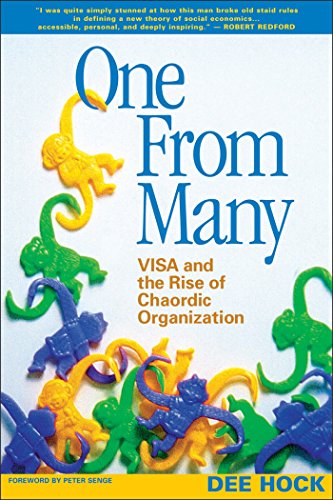
Far more than a riveting inside story of the creation of VISA—now the largest commercial enterprise on earth—One from Many is an absorbing story of personal and institutional transformation. Lyrical, profound, often humorous, it explores the ever-increasing change, complex societal problems, and failing institutions that confront us all. Dee Hock chronicles the emergence of a new form of organization that blends chaos and order, which may be critical to a livable future, and shows how it is emerging in such effective organizations as VISA, the Internet, World Weather Watch, and Alcoholics Anonymous. A beautiful blend of history, biography, and philosophy, One from Many not only challenges the way we think about organizations, management, and our relationship to the natural world, it's a rollicking fine story as well.
This study was supported by the USPHS Research Grant HL34408 from the Heart, Lung, and Blood Institute, U.S.A., the Deutsche Forschungsgemeinschaft (SFB 311, project D10) and the Verband der Chemischen Industrie.
This study was partially supported by the U.S. Public Health research grant HL 34408 from the National Heart, Lung, and Blood Institute and the Commission of the European Communities, Science and Technology for the Development Program. contract No. TS2.013 1 .TH(H). Pranee (Winichagoon) Fucharoen was supported by JSPS Ph.D. dissertation (Ronpaku) program.
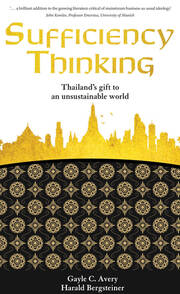
Our world is under pressure, with growing inequalities in wealth and access to food and clean water. We depend too heavily on polluting fuels and diminishing natural resources. Traditional cultural practices are being swamped by global popular culture.
The Thai model of sufficiency thinking aims to transform the mindset of a whole population to achieve the seemingly impossible: enriching everyone's lives in a truly sustainable way.
Innovative management practices developed by King Bhumibol Adulyadej of Thailand have been applied across Thailand in agriculture, education, business, government and community organisations for over two decades.
In this book, chapters written by eminent Thai scholars explain sufficiency thinking and review its implementation in different sectors including community development, business, agriculture, health care, schools, and even in prisons.
Is Thailand unique in having discovered the holy grail of a more responsible form of capitalism? No, it is not, but it is the first country whose government has adopted this kind of thinking as national policy.
'...we obviously need to revise dramatically our thinking about the outlines of a just economy and a decent society in which everyone can lead dignified lives. Sufficiency Thinking provides creative approaches to this quandary and this important volume is a brilliant addition to the growing literature critical of mainstream business-as-usual ideology.' - John Komlos, Professor Emeritus, University of Munich